
Africa Has the Coffee. Now It Needs the Value.
- 31 Aug, 2026
- Home
- 0 Comments
Africa Grows the Coffee. So Why Does Everyone Else Sell It?
Africa produces some of the world's most extraordinary coffee. But somewhere between the farm and the final cup, most of the value leaves the continent. That is the part of the coffee story we need to change.
There is something strange about African coffee.
The continent is home to some of the world's most celebrated coffee-growing regions. From Ethiopia's highlands to Kenya's volcanic soils, Rwanda's washing stations, Uganda's farms and Nigeria's emerging coffee regions, Africa has the land, climate, varieties and generations of farming knowledge needed to produce exceptional coffee.
Yet much of the time, Africa sells its coffee before the most valuable part of the journey begins.
- The beans leave as green coffee.
- They are shipped overseas.
- They are roasted somewhere else.
- They are packaged somewhere else.
- They are branded somewhere else.
And eventually, the coffee returns to consumers at a price many times higher than what was paid at origin.
That isn't simply a coffee problem.
It is a value-chain problem.
The uncomfortable numbers
Africa accounts for roughly 11% of global green coffee production, yet handles less than 2% of global coffee processing.
That gap tells an extraordinary story.
Africa is doing the growing.
But much of the processing, roasting, branding, retailing and foodservice happens elsewhere.
Nigeria provides one of the clearest illustrations.
The country spends approximately $3.48 million a year importing roasted and packaged coffee, while earning less than $200,000 from exporting its own raw green beans.
The same crop.
The same country.
But an enormous difference in economic value.
As the coffee moves further away from the farm, more of the money is captured.
From coffee tree to coffee shop
Think about what happens after a coffee cherry is harvested.
First comes cultivation.
Farmers plant, prune, fertilise and protect the trees. They manage weather risks and wait months for the cherries to mature.
- Then comes harvesting.
- Then processing.
- Fermentation.
- Drying.
- Milling.
- Grading.
- Exporting.
- Roasting.
- Branding.
- Packaging.
- Distribution.
And finally, the cup sitting in a café.
The farmer begins the journey.
But the consumer-facing stages are often happening thousands of kilometres away.
That is where the value multiplies.
The analysis describes this as a five-stage chain: growing, post-harvest processing, roasting, branding/origin identity, and retail or foodservice.
Africa is strongest at the first stage.
The opportunity lies in capturing more of the stages that follow.
The most important 72 hours
One of the most overlooked parts of coffee's value chain happens immediately after harvesting.
The cherry has been picked.
Now what?
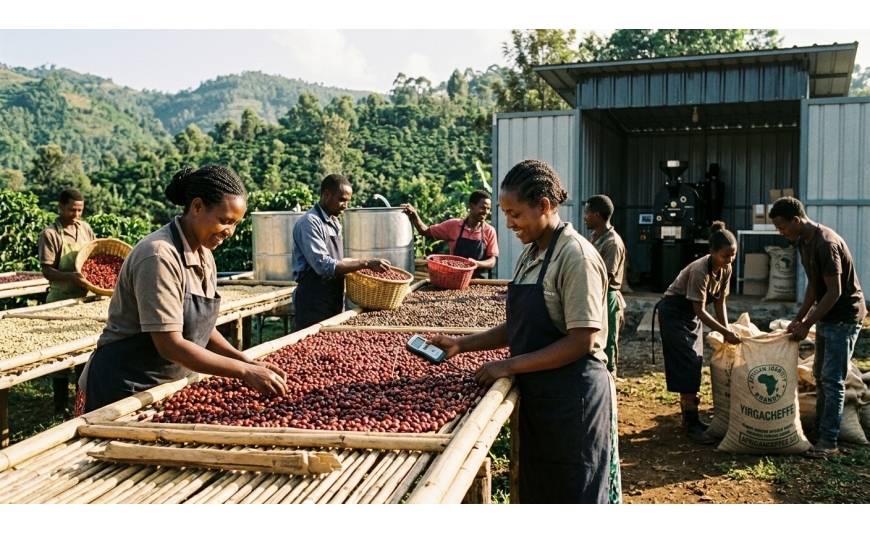
Picking, fermentation, drying and moisture control can determine a huge portion of what eventually reaches the cup.
A beautifully grown coffee can lose much of its potential if post-harvest handling goes wrong.
That means value addition does not necessarily begin with an expensive industrial roastery.
Sometimes it begins with something much closer to the farm:
better processing.
- Raised drying beds.
- Controlled fermentation.
- Reliable washing stations.
- Proper moisture measurement.
- Trained pickers.
- Good storage.
These may sound less glamorous than a modern coffee shop in a European capital.
But they can fundamentally change the quality and value of a coffee.
The refinery problem
There is a useful comparison outside coffee.
For decades, countries such as Nigeria exported crude oil and imported refined petroleum products.
The raw material left the country.
The processed product came back at a higher price.
Coffee follows a remarkably similar pattern.
Africa grows the raw material.
Other markets transform it into the consumer product.
Then Africa — and the rest of the world — buys the finished product.
The solution is not simply to say, "Africa needs more factories."
The bigger question is:
Where should the economic value created by African resources actually remain?
In coffee, even relatively modest investments can move the industry further along the chain: wet mills, dry mills, roasting facilities, packaging operations, quality laboratories and distribution networks.
The issue is not necessarily that value addition is impossible.
It is that it has historically not been treated as a priority.
Africa once held a much bigger share of coffee production
The story becomes even more interesting when you look backwards.
In the 1970s, Africa accounted for around 27% of global coffee production.
Today, the figure is closer to 12.5%.
During the same broad period, Vietnam went from being a relatively minor coffee producer to becoming the world's second-largest producer.
Africa's decline was therefore not inevitable.
The analysis attributes part of the change to external forces, including the rise of Vietnam, Brazilian mechanisation and changing global demand.
But it argues that the larger share was connected to domestic policy failures — including declining research investment, weakened extension services and the dismantling of marketing structures without adequate replacements.
The lesson is important:
Producing coffee is not enough. An industry needs systems around the farmer.
The African coffee value chain needs a redesign
Moving up the value chain does not mean every African country suddenly needs to become a global coffee giant.
It means finding the points where more value can realistically remain at origin.
1. Process closer to where coffee is grown
The first opportunity is processing.
Instead of transporting raw coffee through multiple stages before quality is developed, more of that work can happen near farming communities.
Better processing can improve quality.
Better quality can improve prices.
And better prices can create incentives for farmers to invest in their farms.
2. Make traceability work for farmers
Traceability is becoming increasingly important in global coffee, particularly as European regulations demand greater visibility into supply chains.
But traceability should not exist only to satisfy regulators.
It can also become a commercial tool.
If a buyer knows exactly which farm produced a particular lot, what quality it achieved and how it was processed, that information can support stronger relationships and better price negotiation.
The infrastructure already has to be built.
The question is who benefits from it.
3. Build African coffee identities
Consider names such as Yirgacheffe or Kenya AA.
They are more than geographical references.
They are commercial identities.
They communicate quality, history and origin.
That reputation creates value.
Africa therefore needs to protect and develop more of its own coffee identities through geographical indications, origin branding, quality standards and storytelling.
A region is not automatically a premium brand.
It has to be built into one.
4. Build the African coffee consumer market
There is another opportunity hiding in plain sight.
Africa itself is becoming a major market for coffee.
Across African cities, cafés and specialty coffee businesses are growing.
Yet much of the coffee consumed in these emerging markets can still be imported in roasted or finished form.
That creates an enormous opportunity for African roasters.
A company does not always need to export a finished product to Europe to capture value.
Sometimes the most sustainable first market is home.
The change is already beginning
This is not just theory.
Across Africa, pieces of the new coffee economy are already emerging.
Ethiopia has built powerful origin identities and developed systems around coffee marketing.
Rwanda has invested heavily in washing stations and specialty production.
Kenya has developed one of the world's best-known coffee auction and grading systems.
And now countries that have historically been less prominent on the specialty map are beginning to push forward.
Nigeria, for example, launched a national coffee revival blueprint in August 2026. Plateau State is developing a coffee processing zone through a public-private partnership, while millions of seedlings are being distributed to farmers with traceability built into the programme.
The direction is changing.
Slowly.
But importantly, it is changing.
But roasting coffee in Africa isn't enough
There is an important warning here.
Simply building a roastery does not automatically make the coffee value chain fairer.
A coffee can be roasted in Africa while the farmer remains stuck at the bottom of the value chain.
A traceability system can satisfy European regulations without increasing farmer income.
A specialty coffee can appear on a café menu in Amsterdam without fundamentally changing the economics for the producer.
The question is not simply:
"Can Africa roast its own coffee?"
It is:
"Can Africa capture more value from its coffee while ensuring that farmers share in that value?"
That requires strong cooperatives, transparent pricing, reliable offtake agreements and commercial structures designed to pass value back through the chain.
The system has to be built differently from the beginning.
The future isn't just exporting better green coffee
For years, the ambition across African coffee has often been:
Produce better coffee. Get a better price. Export more.
That is still important.
But perhaps the bigger opportunity is:
Produce better coffee. Process it at origin. Build its identity. Roast it. Package it. Sell it. And create an African consumer market around it.
That is a completely different economic model.
It means the coffee farmer is no longer simply supplying a raw material.
The origin becomes part of the brand.
The processing becomes part of the value.
The story becomes part of the product.
And the consumer gets to experience African coffee as something created at origin, rather than something that simply passed through it.
Africa's greatest coffee asset may be what happens after the harvest
The continent already has many of the things the coffee industry cannot manufacture.
- Altitude.
- Volcanic soils.
- Unique varieties.
- Biodiversity.
- Exceptional growing regions.
- Generations of agricultural knowledge.
- And millions of people who understand coffee farming.
What Africa has lacked is enough of the infrastructure and commercial systems needed to turn those advantages into greater economic value.
That is beginning to change.
And perhaps the most exciting part is that the opportunity is not limited to the traditional coffee giants.
There are emerging origins.
There are forgotten varieties.
There are young farmers.
There are new roasters.
There are African brands.
There are consumers discovering specialty coffee for the first time.
And there are entire sections of the value chain still waiting to be built.
The real question
Africa does not need to prove that it can grow exceptional coffee.
It already has.
The question is what happens after the cherry leaves the tree.
Who processes it?
Who roasts it?
Who builds the brand?
Who tells the story?
Who sells the final product?
And, most importantly:
Who gets paid for the value created along the way?
The future of African coffee may depend less on producing more beans and more on ensuring that more of the value stays where the story begins.
At shop.africancity.ch, that is a future worth watching.
Because African coffee should not only be grown in Africa.
More of its value should be created there too.





0 Comments